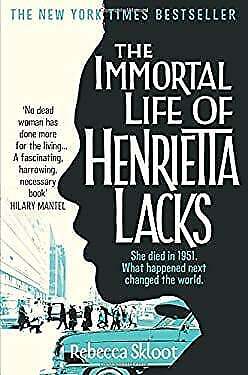
Her name was Henrietta Lacks, but scientists know her as HeLa. She was a poor Southern tobacco farmer who worked the same land as her slave ancestors, yet her cells—taken without her knowledge—bcame one of the most important tools in medicine: The first “immortal” human cells grown in culture, which are still alive today, though she has been dead for more than sixty years. HeLa cells were vital for developing the polio vaccine; uncovered secrets of cancer, viruses, and the atom bomb’s effects; helped lead to important advances like in vitro fertilization, cloning, and gene mapping; and have been bought and sold by the billions.
Yet Henrietta Lacks remains virtually unknown, buried in an unmarked grave.
Henrietta’s family did not learn of her “immortality” until more than twenty years after her death, when scientists investigating HeLa began using her husband and children in research without informed consent. And though the cells had launched a multimillion-dollar industry that sells human biological materials, her family never saw any of the profits. As Rebecca Skloot so brilliantly shows, the story of the Lacks family—past and present—is inextricably connected to the dark history of experimentation on African Americans, the birth of bioethics, and the legal battles over whether we control the stuff we are made of.
Over the decade it took to uncover this story, Rebecca became enmeshed in the lives of the Lacks family—especially Henrietta’s daughter Deborah. Deborah was consumed with questions: Had scientists cloned her mother? Had they killed her to harvest her cells? And if her mother was so important to medicine, why couldn’t her children afford health insurance?
Intimate in feeling, astonishing in scope, and impossible to put down, The Immortal Life of Henrietta Lacks captures the beauty and drama of scientific discovery, as well as its human consequences.
About the Author
Rebecca Skloot is the author of the #1 New York Times Bestseller, The Immortal Life of Henrietta Lacks, which was made into an Emmy Nominated HBO film starring Oprah Winfrey as Deborah Lacks, Renee Elise Goldsberry as Henrietta Lacks, and Rose Byrne as Rebecca Skloot. Her award-winning science writing has appeared in The New York Times Magazine; O, The Oprah Magazine, and many other publications. She specializes in narrative science writing and has explored a wide range of topics, including goldfish surgery, tissue ownership rights, race and medicine, food politics, and packs of wild dogs in Manhattan. She has worked as a correspondent for WNYC’s Radiolab and PBS’s Nova ScienceNOW. She and her father, Floyd Skloot, co-edited The Best American Science Writing 2011. You can read a selection of Rebecca Skloot’s magazine writing on the article page of this site.
The Immortal Life of Henrietta Lacks, Skloot’s debut book, took more than a decade to research and write, and instantly hit the New York Times best-seller list, where it has remained for more than seven years since its publication. She has been featured on numerous television shows, including CBS Sunday Morning, The Colbert Report, and others, and was named One of Five Surprising Leaders of 2010 by the Washington Post. The Immortal Life was chosen as the best book of 2010 by more than 60 media outlets, including Entertainment Weekly, National Public Radio, People Magazine, and The New York Times; it was named The Best Book of 2010 and one of the 100 Books to Read in a Lifetime by Amazon.com, and a Barnes and Noble Discover Great New Writers Pick. It was translated into 25 languages and won numerous awards, including the National Academies of Science Best Book of the Year award, and received widespread critical acclaim with reviews appearing in The New Yorker, Washington Post, Science, and many others. Dwight Garner of the New York Times said, “I put down Rebecca Skloot’s first book, “The Immortal Life of Henrietta Lacks,” more than once. Ten times, probably. Once to poke the fire. Once to silence a pinging BlackBerry. And eight times to chase my wife and assorted visitors around the house, to tell them I was holding one of the most graceful and moving nonfiction books I’ve read in a very long time …It has brains and pacing and nerve and heart.
Skloot is the founder and president of The Henrietta Lacks Foundation, which has been featured in the New York Times. She has a B.S. in biological sciences and an MFA in creative nonfiction. She financed her degrees by working in emergency rooms, neurology labs, veterinary morgues and martini bars. She has taught creative writing and science journalism at the University of California Berkeley, New York University, the University of Memphis, and the University of Pittsburgh. She is a regularly featured speaker at conferences and universities worldwide.
Skloot currently lives with her dog Clarence and cat Phineas in Oakland, California, where she is Working on a new book about humans, animals, science, and ethics, a topic near and dear to her: Before becoming a science writer, Skloot spent more than a decade working as a veterinary technician in animal shelters, vet clinics, emergency rooms, shelters, research labs, and an animal morgue. Those experiences, and the ethical questions they prompted, are at the centre of her book-in-progress, which explores the often-controversial topic of animal research through a deeply personal story about our complex relationships with animals — their roles in our lives, and in science — and the humans who battle over their fates, and as a result, our own. Skloot is also a knitter, a family tradition passed on from her mother, Betsy McCarthy, a professional knitter whose story was featured on Your Life Calling with Jane Pauley.

Reviews
There are no reviews yet.