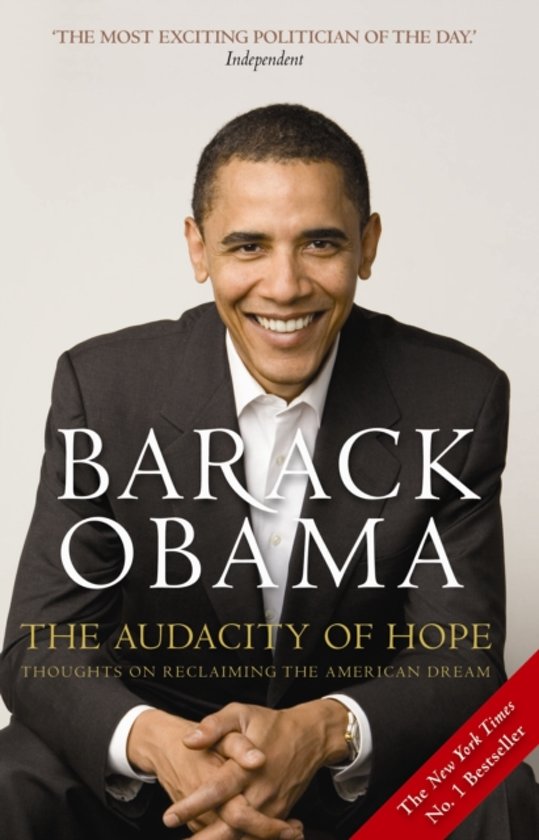
In July 2004, four years before his presidency, Barack Obama electrified the Democratic National Convention with an address that spoke to Americans across the political spectrum. One phrase in particular anchored itself in listeners’ minds, a reminder that for all the discord and struggle to be found in our history as a nation, we have always been guided by a dogged optimism in the future, or what Obama called “the audacity of hope.”
The Audacity of Hope is Barack Obama’s call for a different brand of politics—a politics for those weary of bitter partisanship and alienated by the “endless clash of armies” we see in Congress and on the campaign trail; a politics rooted in the faith, inclusiveness, and nobility of spirit at the heart of “our improbable experiment in democracy.” He explores those forces—from the fear of losing to the perpetual need to raise money to the power of the media—that can stifle even the best-intentioned politician. He also writes, with surprising intimacy and self-deprecating humour, about settling in as a senator, seeking to balance the demands of public service and family life, and his own deepening religious commitment.
At the heart of this book is Barack Obama’s vision of how we can move beyond our divisions to tackle concrete problems. He examines the growing economic insecurity of American families, the racial and religious tensions within the body politic, and the transnational threats—from terrorism to pandemic—that gather beyond our shores. And he grapples with the role that faith plays in a democracy—where it is vital and where it must never intrude. Underlying his stories is a vigorous search for connection: the foundation for a radically hopeful political consensus.
Only by returning to the principles that gave birth to our Constitution, Obama says, can Americans repair a political process that is broken, and restore to working order a government that has fallen dangerously out of touch with millions of ordinary Americans. Those Americans are out there, he writes—“waiting for Republicans and Democrats to catch up with them.”
About the Author
When Barack Obama was elected president in 2008, he became the first African American to hold the office. The framers of the Constitution always hoped that our leadership would not be limited to Americans of wealth or family connections. Subject to the prejudices of their time—many of them owned slaves—most would not have foreseen an African American president. Obama’s father, Barack Sr., a Kenyan economist, met his mother, Stanley Ann Dunham when both were students in Hawaii, where Barack was born on August 4, 1961. They later divorced, and Barack’s mother married a man from Indonesia, where he spent his early childhood. Before fifth grade, he returned to Honolulu to live with his maternal grandparents and attend Punahou School on scholarship.
In his memoir Dreams from My Father (1995), Obama describes the complexities of discovering his identity in adolescence. After two years at Occidental College in Los Angeles, he transferred to Columbia University, where he studied political science and international relations. Following graduation in 1983, Obama worked in New York City, then became a community organizer on the South Side of Chicago, coordinating with churches to improve housing conditions and set up job-training programs in a community hit hard by steel mill closures. In 1988, he went to Harvard Law School, where he attracted national attention as the first African American president of the Harvard Law Review. Returning to Chicago, he joined a small law firm specializing in civil rights.
In 1992, Obama married Michelle Robinson, a lawyer who had also excelled at Harvard Law. Their daughters, Malia and Sasha, were born in 1998 and 2001, respectively. Obama was elected to the Illinois Senate in 1996, and then to the U.S. Senate in 2004. At the Democratic National Convention that summer, he delivered a much-acclaimed keynote address. Some pundits instantly pronounced him a future president, but most did not expect it to happen for some time. Nevertheless, in 2008 he was elected over Arizona Senator John McCain by 365 to 173 electoral votes.
As an incoming president, Obama faced many challenges—an economic collapse, wars in Iraq and Afghanistan, and the continuing menace of terrorism. Inaugurated before an estimated crowd of 1.8 million people, Obama proposed unprecedented federal spending to revive the economy and also hoped to renew America’s stature in the world. During his first term, he signed three signature bills: an omnibus bill to stimulate the economy, legislation making health care more accessible and affordable, and legislation reforming the nation’s financial institutions. Obama also pressed for a fair pay act for women, financial reform legislation, and efforts for consumer protection. In 2009, Obama became the fourth president to receive the Nobel Peace Prize.
In 2012, he was reelected over former Massachusetts Governor Mitt Romney by 332 to 206 electoral votes. The Middle East remained a key foreign policy challenge. Obama had overseen the killing of Osama bin Laden, but a new self-proclaimed Islamic State arose during a civil war in Syria and began inciting terrorist attacks. Obama sought to manage a hostile Iran with a treaty that hindered its development of nuclear weapons. The Obama administration also adopted a climate change agreement signed by 195 nations to reduce greenhouse gas emissions and slow global warming.
In the last year of his second term, Obama spoke at two events that clearly moved him—the 50th anniversary of the civil rights march from Selma to Montgomery and the dedication of the National Museum of African American History and Culture. “Our union is not yet perfect, but we are getting closer,” he said in Selma. “And that’s why we celebrate,” he told those attending the museum opening in Washington, “mindful that our work is not yet done.”
Other Books by the Author
A Promised land
Of Thee I Sing: A Letter to my daughter
Dreams from my father



Reviews
There are no reviews yet.