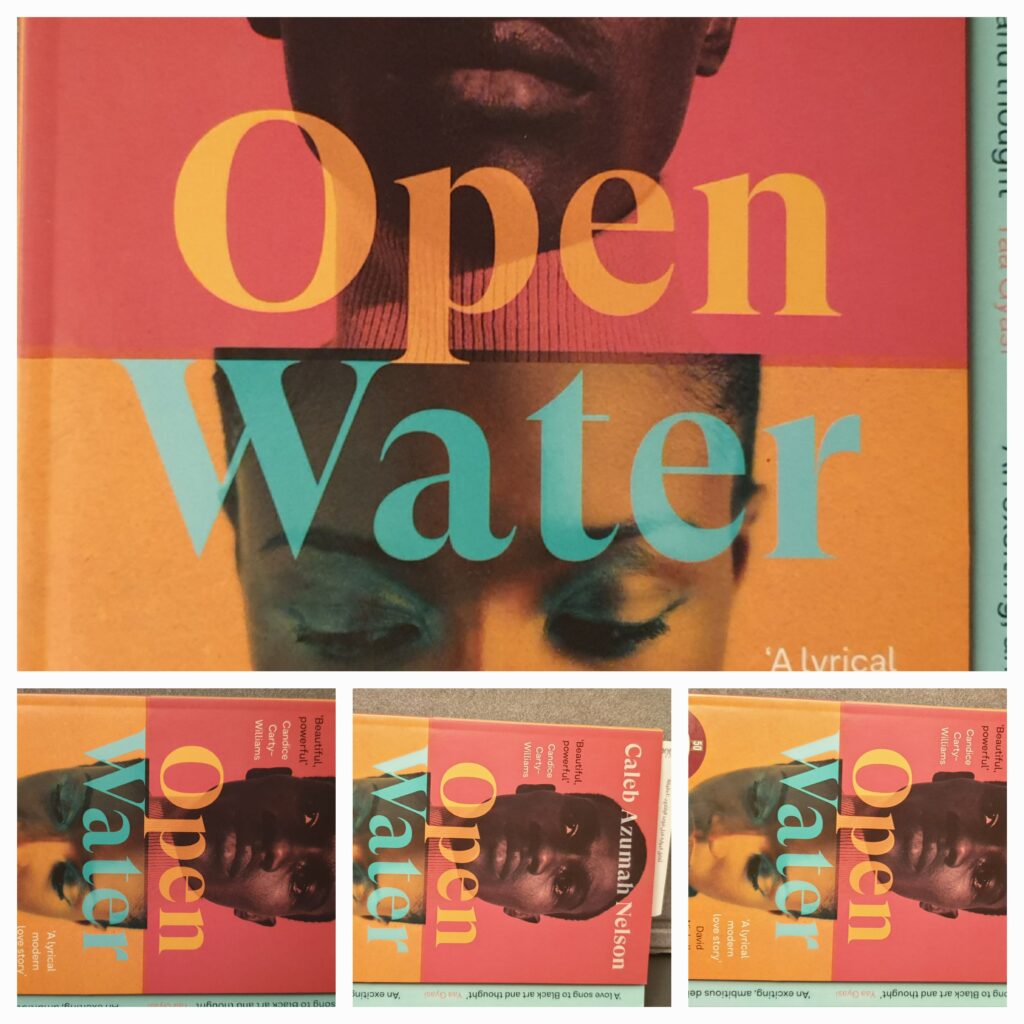
By Jacquie Joy
Two young people meet at a pub in South East London. Both are Black British, both won scholarships to private schools where they struggled to belong, both are now artists – he a photographer, she a dancer – trying to make their mark in a city that by turns celebrates and rejects them. Tentatively, tenderly, they fall in love. But two people who seem destined to be together can still be torn apart by fear and violence.
At once an achingly beautiful love story and a potent insight into race and masculinity, Open Water asks what it means to be a person in a world that sees you only as a Black body, to be vulnerable when you are only respected for strength, to find safety in love, only to lose it. With gorgeous, soulful intensity, Caleb Azumah Nelson has written the most essential British debut of recent years.
This book has had so many great reviews and has been shortlisted for many prizes so I was really looking forward to it. However having finished it I have mixed feelings.
What I liked;
- Second person narrative – It’s not often that I read books written in the second person narrative so it’s always a great pleasure to come across one. I love the second person narrative because it puts you write in the centre of the action and I find that you build a more intimate relationship with the characters.
- The final quarter of the book really rocked me to the core, I felt his trauma and pain and totally helpless because I couldn’t help him. Caleb-Azumah describes so well what it is like being a young black man in Britain and opened my eyes to the trauma brothers experienced but were perhaps too afraid, or too proud to articulate, because boys are not supposed to be vulnerable, right?
- I loved the writing style, the succinct sentence structure, the repetition of phrases is very reminiscent of African story telling.
- It is poignant with gems of humour “Faith is turning off the light and trusting the other person will not murder you in your sleep”
What I didn’t like;
- The frequent references to content by other artist; books, films, music. I was not familiar with many of these and constantly interrupting the flow to look them up was frustrating. Once, twice or thrice I can understand, here it was excessive.
- Whilst I sympathised with the main protagonist, I lost patience with him, he was too emotional for my liking, (but I think I may be the one with the problem, not him).
- The first 3/4 of the book just dragged because the “love story” just went on and on and on.
- I would have liked to know more about his family. Why for example does he say that he raised his brother?