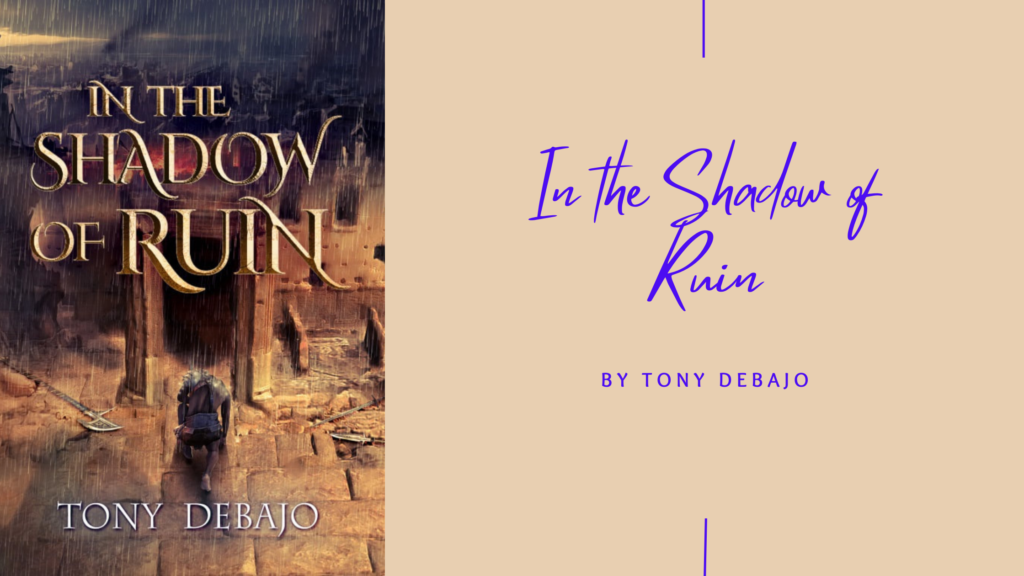
A Review by Taiwo Awoyungbo
In the Shadow of Ruin, Tony Debajo’s debut novel is the first in the (planned three book) Fractured Kingdom series, and it shows. This thrilling story (and I anticipated really enjoying reading about the fall of a fictional ancient Yoruba kingdom) may improve as the series progresses. But reading it as a stand-alone novel I found less than satisfying. Am I saying I think this is a bad book? Not at all! It was an easy read, just not a great read for me.
The story explores the way of life, superstitions and ingenuities of a civilization. It is the story of man’s base desire to seek and seize power and the lengths some would take to survive.
What I liked about the book
I found many things to appreciate in this book, from the helpful glossary and the diverse characters belonging to different tribes and ethnicities, to the intriguing chapter headings that made me curious about their meaning. The first chapter, ‘Rituals’, hooked me right away with its introduction of King Jide, his location and his high stakes.
The dialogue was also well-written, with some humor even in dire situations, such as when Dare joked about his cheek wound that exposed his teeth and gums. The action scenes were thrilling, with vivid descriptions of hand-to-hand combat and skirmishes. I also enjoyed seeing how the characters changed over the course of the story, such as Prince Toju’s cynical views on the people and King Jide’s regrets about the war and its consequences.
The book also gave me a rich insight into the culture and religion of the people, with explanations of their offerings to the Babalawo’s and their encounters with the Orisha’s, such as King Jide’s meeting with Yemoja and Enitan’s encounter with an unnamed god.
What didn’t work
The characters were poorly developed and I could not empathize with any of them. I expected the protagonists to have rich and vivid personalities, and the antagonists and secondary characters to have some depth and complexity. However, the main villain, Ekate, was a flat and stereotypical character who only had a brief backstory to explain her motives. She could have been a fascinating and flawed character, but she was not. The same goes for most of the other characters, who were either too perfect or too evil to be realistic.
I found the use of italics for some chapters confusing and unnecessary. What was the purpose of this stylistic choice? It did not seem to add anything to the story or the narration.
Moreover, I felt let down by the climax of the military strategy, which was supposed to be a tense and thrilling moment. The author built up the suspense by describing how the Westerners were racing to enter Benin city before the gates closed, but then resolved it in a disappointing way. The outcome was rather anticlimactic.
I was also annoyed by how many of the characters were unrealistically attractive. For example, when Toju finally saw his bride Habiba’s face for the first time after five days of lavish wedding ceremonies, he was not surprised to find that she was “the most beautiful person he had ever seen”. This seemed too convenient and clichéd. Moreover, I was frustrated by how few female characters had any agency or significance in the story. Habiba was one of them, but she was reduced to a mere object of beauty and desire.
Finally, I thought the depiction of the first assassination attempt on King Jide’s life was clumsy and implausible. How could a stray dog wander around the palace unnoticed and attack the king? How could King Jide coincidentally bump into Aniekan, the girl he liked, two days after he met her at court? Wouldn’t he have more discreet and effective ways of contacting her? These events seemed contrived and unrealistic.
In closing
There were fascinating storylines that could have been but were not explored. I would recommend it to someone who loves historical fiction based on fact. For the YA reader it could serve as a primer to ancient Yoruba kingdoms in southern Nigeria, with associated political manoeuvrings and bloodthirsty warfare. Or for anyone seeking an introduction into the way of life, beliefs and culture of ancient West African civilizations, they would probably find this book an interesting read.